
1. Introdución
The ASUS ROG Strix X570-E Gaming ATX Motherboard is designed to deliver robust performance and extensive features for 2nd and 3rd generation AMD Ryzen AM4 processors. It integrates advanced connectivity and cooling solutions to enhance your computing experience. Key features include:
- Soquete AMD AM4 e PCIe 4.0: Optimized for Zen 3 Ryzen 5000 & 3rd Gen AMD Ryzen CPUs, offering the latest in connectivity.
- Aura Sync RGB: ASUS-exclusive Aura Sync RGB lighting with RGB headers and addressable Gen 2 headers for personalized aesthetics.
- Refrixeración integral: Features an active PCH heatsink, MOS heatsink with 8mm heatpipe, dual on-board M.2 heatsinks, and a water pump plus header to maintain optimal temperatures.
- Gaming Connectivity: Supports PCIe 4.0, HDMI 2.0, DisplayPort 1.2, dual M.2 slots, and USB 3.2 Type-A and Type-C connectors.
- Redes de xogos: Equipped with 2.5Gbps LAN and Intel Gigabit Ethernet with ASUS LANGuard, Wi-Fi 6 (802.11Ax) with MU-MIMO, and Gateway teaming via GameFirst V for superior online performance.
2. Configuración
Placa base 2.1view
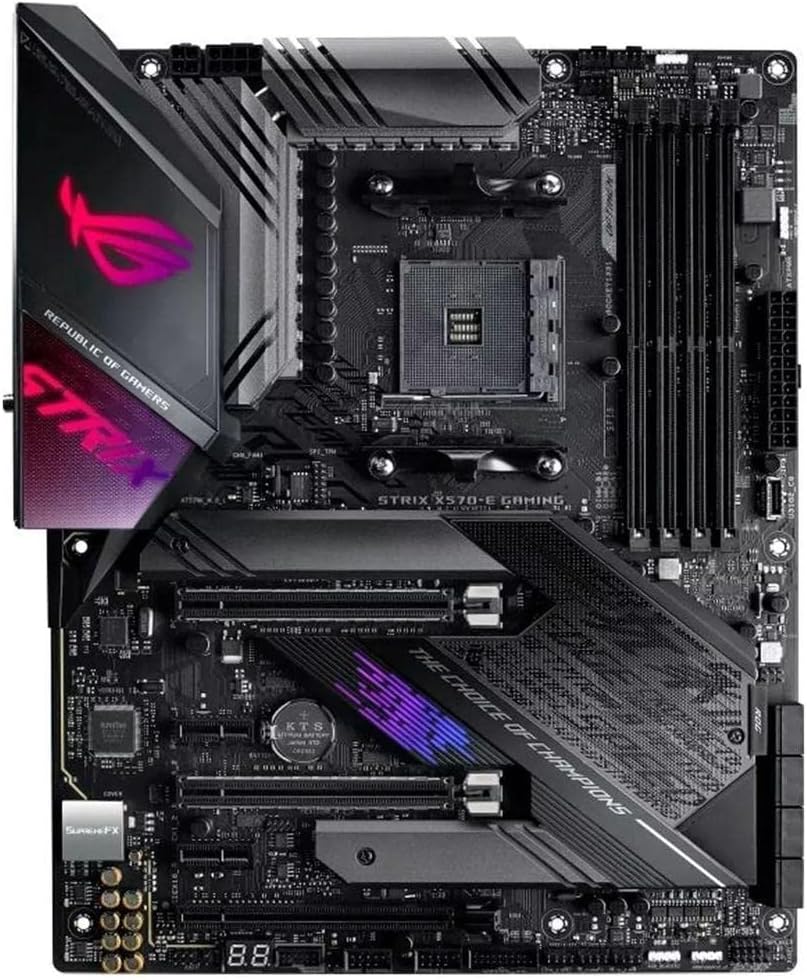
Figura 1: De arriba abaixo view of the ASUS ROG Strix X570-E Gaming Motherboard, highlighting the CPU socket, DIMM slots, and heatsinks.
2.2 Instalación da CPU
This motherboard features an AM4 socket, compatible with AMD Ryzen 5000 and 3000 series processors. Carefully align your CPU with the socket, ensuring the golden triangle on the CPU matches the triangle on the socket. Lower the CPU into place without force and secure the retention arm.
2.3 Instalación da memoria (RAM)
The motherboard supports up to 128GB of DDR4 memory across four DIMM slots. For optimal performance, install memory modules in the recommended dual-channel configuration as specified in the detailed manual. Open the clips on both ends of the DIMM slot, align the memory module, and press firmly until the clips snap into place.
2.4 Conexións de enerxía
Connect the 24-pin ATX power connector from your power supply to the corresponding port on the motherboard. Additionally, connect the 8-pin EPS 12V power connector (and optionally the 4-pin connector if your power supply has it and your system demands high power) to the CPU power ports located near the CPU socket.
2.5 Storage (M.2 SSDs)

Figure 2: Motherboard view with M.2 heatsinks removed, revealing the M.2 slots for SSD installation.
The motherboard features dual M.2 slots, both equipped with heatsinks for optimal thermal management of high-speed NVMe SSDs. To install an M.2 SSD, remove the heatsink, insert the SSD into the slot, and secure it with the provided screw or tool-less latch mechanism. Reattach the heatsink after installation.
Tarxetas de expansión 2.6 (PCIe)
The motherboard includes multiple PCIe 4.0 slots, with the primary PCIe 4.0 x16 slot being metal-reinforced for heavy graphics cards. Align your expansion card with the desired slot and press firmly until it is seated correctly. Secure the card with a screw to your chassis.
2.7 Panel de E/S traseiro

Figura 3: detallada view of the motherboard's rear input/output panel, showing various ports and connectors.
The integrated I/O shield provides a range of connectivity options:
- Saídas de vídeo: HDMI 2.0, DisplayPort 1.2
- Portos USB: Multiple USB 3.2 Gen 2 Type-A and Type-C ports.
- Rede: 2.5Gbps LAN and Intel Gigabit Ethernet.
- Sen fíos: Wi-Fi 6 (802.11Ax) antenna connectors.
- Conectores de son: Standard 3.5mm audio jacks and S/PDIF optical out.
- Utility Buttons: BIOS Flashback button and Clear CMOS button.
2.8 Internal Headers
Connect front panel USB ports, fan headers, and RGB lighting strips to the corresponding headers on the motherboard. Refer to the detailed manual for exact header locations and pin configurations.
3. En funcionamento
3.1 Configuración da BIOS/UEFI
To access the BIOS/UEFI setup, press the DEL or F2 key during system startup. The UEFI BIOS Utility offers various modes, including EZ Mode for basic settings and Advanced Mode for detailed configurations. Within Advanced Mode, you can adjust CPU and memory settings (AI Tweaker), monitor system status (Monitor), configure boot options (Boot), and access utility tools (Tool).
3.2 Software Features (Armoury Crate)
Install ASUS Armoury Crate software from the official ASUS website to unlock full control over your motherboard's features. Armoury Crate provides a centralized dashboard for:
- Monitorización do sistema: Real-time display of CPU frequency, core voltage, temperature, and fan speeds.
- Sincronización de aura: Synchronize RGB lighting effects across compatible ASUS components and peripherals.
- Control do ventilador: Adjust fan curves and profiles for optimal cooling and noise levels.
- Scenario Profiles: Create and manage performance profiles for different usage scenarios (e.g., gaming, silent).
Video 1: Official ASUS ROG X570 Series Motherboard overview, mostrarasinCaracterísticas e deseño clave de g.
4. Mantemento
4.1 Sistema de refrixeración
The motherboard's comprehensive cooling system, including active PCH heatsink, MOS heatsink, and dual M.2 heatsinks, is designed to maintain stable performance. Ensure proper airflow within your PC case and regularly clean dust from fans and heatsinks to prevent overheating.
4.2 Actualizacións da BIOS
Consulta regularmente o soporte técnico de ASUS website for the latest BIOS updates. Updating your BIOS can improve system stability, compatibility, and performance. The motherboard features a BIOS Flashback button on the rear I/O panel, allowing you to update the BIOS without a CPU or memory installed. Refer to the detailed manual for the BIOS Flashback procedure.
5 Solución de problemas
5.1 Q-Code Display
The motherboard features a Q-Code display (POST code display) that shows two-digit codes during startup. These codes can help diagnose issues if your system fails to boot. Refer to the motherboard manual's troubleshooting section for a list of Q-Codes and their meanings.
5.2 Botón Borrar CMOS
If you encounter system instability or boot issues after changing BIOS settings, you can use the Clear CMOS button on the rear I/O panel to reset the BIOS to its default settings. Power off your system and press the Clear CMOS button for a few seconds.
6. Especificacións
| Característica | Especificación |
|---|---|
| Marca | ASUS |
| Serie | ROG STRIX X570-E GAMING |
| Número de modelo do artigo | ROG STRIX X570-E GAMING |
| Socket CPU | Enchufe AM4 |
| Procesadores compatibles | AMD 3rd Generation Ryzen (Zen 3 Ryzen 5000 & 3rd Gen AMD Ryzen CPUs) |
| Tipo de chipset | AMD 570X |
| Tecnoloxía de memoria RAM | Memoria DDR4 SDRAM (DIMM) |
| Velocidade da memoria | 2133 MHz (supports up to 4400 MHz via overclocking) |
| Capacidade máxima de RAM | 128 GB |
| Tipo sen fíos | Wi-Fi 6 (802.11Ax) with MU-MIMO, Bluetooth |
| LAN | 2.5Gbps LAN and Intel Gigabit Ethernet with ASUS LANGuard |
| Slots PCIe | Soporte PCIe 4.0 |
| M.2 Ranuras | Dual on-board M.2 heatsinks |
| Portos USB 2.0 | 2 |
| Peso do elemento | 2.5 libras |
| Dimensións do produto | 13.5 x 10.75 x 3.03 polgadas |
7. Garantía e soporte
For warranty information, technical support, and driver downloads, please visit the official ASUS support website. You can find detailed contact information and resources by searching for your specific motherboard model.
Soporte ASUS Websitio: www.asus.com/support/