1. Introdución
This manual provides essential information for the safe and efficient use of your Nokia 8800 Unlocked Cell Phone. Please read this guide carefully before operating the device to ensure proper functionality and to understand its features.

Image: The Nokia 8800 phone in a partially slid-open position, revealing the keypad and screen.
2. Configuración
2.1 Instalación da tarxeta SIM e da batería
- Remove the back cover of the phone by sliding it downwards or pressing the release button, if present.
- Insert your SIM card into the designated slot with the gold contacts facing down and the cut corner aligned correctly.
- Place the battery into the battery compartment, ensuring the contacts align with those on the phone.
- Volva colocar a tapa traseira ata que encaixe firmemente no seu lugar.

Image: The Nokia 8800 phone with its back cover removed, revealing the internal battery compartment and SIM card slot. A separate back cover is shown next to it.
2.2 Carga da batería
Before first use, fully charge the phone's battery. Connect the charger to the phone's charging port and plug it into a power outlet. The battery indicator on the screen will show the charging status.

Image: The Nokia 8800 phone placed upright in a dedicated charging dock.
2.3 Acendido/Apagado
To power on, press and hold the power key (usually the red end call key) until the Nokia logo appears. To power off, press and hold the same key until the 'Power off' option appears, then select it.
3. Instrucións de funcionamento
3.1 Facer e recibir chamadas
- Facendo unha chamada: Enter the phone number using the keypad and press the green call key.
- Respondendo a unha chamada: Press the green call key when the phone rings.
- Finalizando unha chamada: Press the red end call key.
3.2 Envío de mensaxes
Navigate to the 'Messages' menu. Select 'Create new message' or 'New SMS/MMS'. Enter your text, add multimedia content if sending an MMS, and then enter the recipient's number or select from contacts before sending.
3.3 Uso da cámara
Access the camera from the main menu. Frame your shot using the display and press the dedicated camera key or the center navigation key to capture an image. The integrated SVGA camera supports still images and improved video recording quality (QCIF).
3.4 Internet Browsing
The Nokia 8800 features an integrated xHTML browser that connects over TCP/IP. Access the browser from the main menu to navigate web pages. Data transfer is supported via EDGE/E-GPRS (Class 8) and GPRS (Class 8).

Image: The Nokia 8800 phone with its screen displaying 'Telekom.de', indicating network or service provider information.
4. Características
The Nokia 8800 is designed with a focus on premium materials and functionality:
- Visualización: High-resolution TFT display with 256K colors and 208 x 208 pixel resolution.
- Imaxe: Integrated SVGA camera (0.5 megapixels) with improved video recording quality (QCIF).
- Mensaxería: Supports text, audio, image, and video clips (MMS up to 300 KB). Email support for SMTP, POP3, and IMAP4 protocols. Predictive text input for major languages.
- Memoria: 64MB internal NAND flash memory.
- Conectividade: Bluetooth (Stereo, Plug & Play connector, SIM Access Profile), EDGE/E-GPRS, GPRS.
- Funcións de voz: Integrated handsfree speaker.
- Medios: 64 polyphonic MIDI, AAC, MP3 ringing tones. Video recording and streaming. Digital music player and FM Radio.
- Aplicacións: Java MIDP 2.0 for applications and games.
- Características especiais: Exclusive 3D graphics and UI themes, Mobile Wallet 2.0 application, device-to-device synchronization.

Image: The Nokia 8800 phone in its closed, compact form, showcasing o seu elegante deseño.
5. Mantemento
5.1 Limpeza do dispositivo
Use a soft, lint-free cloth to clean the phone's screen and body. Avoid using harsh chemicals or abrasive materials, as these can damage the finish and display.
5.2 Coidado coa batería
To prolong battery life, avoid exposing the phone to extreme temperatures. Do not leave the battery fully discharged for extended periods. Use only Nokia-approved chargers and batteries.
5.3 Manexo xeral
Protect your phone from drops, impacts, and moisture. Keep it away from magnetic fields and direct sunlight.
6 Solución de problemas
6.1 Problemas comúns e solucións
- O teléfono non se acende: Ensure the battery is charged and correctly inserted. Try connecting the charger.
- Sen sinal de rede: Check if the SIM card is properly inserted. Move to an area with better network coverage. Contact your service provider if the issue persists.
- A batería non se carga: Verify the charger connection. Ensure the charger is functional. Check for any damage to the charging port.
- A pantalla non responde: Try restarting the phone. If the issue continues, contact support.
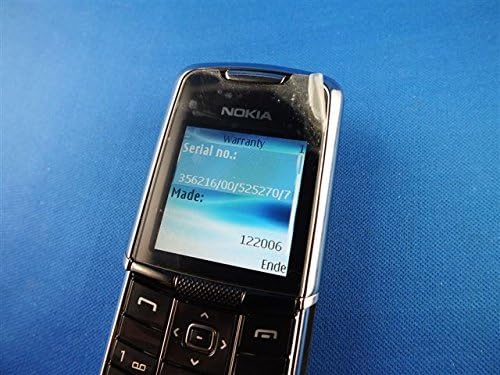
Image: The Nokia 8800 phone with its screen displaying 'Warranty' and 'Serial no.' information, useful for troubleshooting or support inquiries.
7. Especificacións
| Característica | Detalle |
|---|---|
| Nome do modelo | Nokia 8800 |
| Frecuencia de operación | Tri-band GSM 900/1800/1900 |
| Dimensións (L x A x P) | 107 mm x 45 mm x 15.0 - 16.5 mm |
| Peso | 134 g (4.7 onzas) |
| Mostrar | High-resolution TFT, 256K colors, 208 x 208 pixels, 2 inches |
| Cámara | SVGA (0.5 megapixels), QCIF video recording |
| Memoria interna | Flash NAND de 64 MB |
| Sistema Operativo | Java-based (proprietary) |
| Conectividade | Bluetooth, EDGE/E-GPRS Class 8, GPRS Class 8 |
| Navegador | Integrated xHTML browser |
| Jack de audio | Sen toma de auriculares |
| Factor de forma | Control deslizante |
| Cor | Prata |
| Data de primeira dispoñibilidade | 13 de febreiro de 2007 |
8. Garantía e soporte
For warranty information and customer support, please refer to the documentation provided at the time of purchase or visit the official Nokia websitio. Garda o comprobante de compra para calquera reclamación de garantía.


