1. Introdución
This manual provides essential instructions for the safe and efficient use of your KOAMTAC KDC280 Barcode Data Collector. The KDC280 is a compact and versatile device designed for collecting 1D and 2D barcode data, offering flexible connectivity options via Bluetooth and USB. Please read this manual thoroughly before operating the device and retain it for future reference.
2. Información de seguridade
- Non expoñas o dispositivo a temperaturas extremas, humidade nin substancias corrosivas.
- Evite deixar caer o dispositivo nin someterlo a impactos fortes.
- Non intente desmontar nin modificar o dispositivo. Isto anulará a garantía e pode causar danos.
- Use only the charging cradle and accessories provided or approved by KOAMTAC.
- Manteña o dispositivo lonxe de campos magnéticos fortes.
- Elimina as baterías segundo a normativa local.
3. Contido do paquete
Verify that all items are present in your KDC280 package:
- KOAMTAC KDC280 Barcode Data Collector
- Dongle Bluetooth USB
- Base de carga
- Cable USB
- Acollador
- Manual rápido

Image: The KOAMTAC KDC280 data collector shown with its charging cradle, USB Bluetooth dongle, and lanyard.
4. Produto rematadoview
The KDC280 is a miniature barcode data collector capable of reading both 1D and 2D barcodes. It features a small display for user feedback and navigation buttons. Its primary function is to scan and store barcode data or transmit it in real-time to a host device via Bluetooth or USB.
Imaxe: Primeiro plano view of the KDC280 device, its charging cradle, and the USB Bluetooth dongle.
5. Configuración
5.1. Charging the KDC280
Before initial use, fully charge the KDC280 battery. Place the KDC280 into the charging cradle. Connect the USB cable to the charging cradle and then to a power source (e.g., computer USB port or USB wall adapter). The device's display will indicate charging status.
5.2. Connecting via USB Bluetooth Dongle
For quick and automatic pairing with a host device, use the included USB Bluetooth dongle.
- Insert the USB Bluetooth dongle into an available USB port on your computer or host device.
- Power on the KDC280.
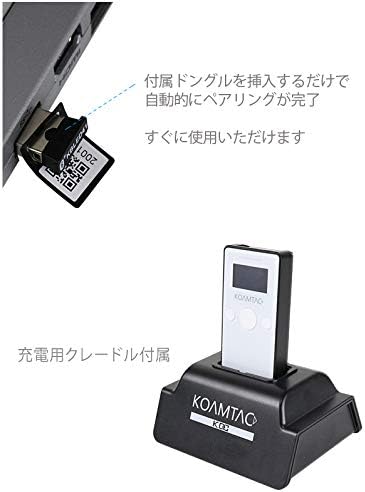
- The KDC280 will automatically detect and pair with the dongle. A confirmation message will appear on the KDC280's display once pairing is successful. The device is then ready for immediate use.

Image: Illustration showing the USB Bluetooth dongle being inserted into a port, enabling automatic pairing with the KDC280. The charging cradle is also visible.
5.3. Connecting via Standard Bluetooth
To connect to a host device without the dongle, follow the standard Bluetooth pairing procedure:
- Ensure Bluetooth is enabled on your host device (e.g., smartphone, tablet, computer).
- On the KDC280, navigate to the Bluetooth menu and select 'Pairing Mode'.
- On your host device, search for available Bluetooth devices. Select 'KDC280' from the list.
- Siga as indicacións en pantalla para completar o proceso de vinculación.
6. Operating the KDC280
6.1. Acendido/apagado
- Para acender: Prema e manteña premido o botón de acendido ata que a pantalla se ilumine.
- To power off: Press and hold the power button until the 'Power Off' option appears on the display, then confirm.
6.2. Escaneado de códigos de barras
- Point the KDC280's scanner window at the barcode.
- Press the scan button. A successful scan will typically be indicated by a beep and/or a green LED light.
- The scanned data will appear on the KDC280's display and/or be transmitted to the connected host device.
6.3. Transferencia de datos
When connected via Bluetooth, scanned data is typically transmitted in real-time to the host application. If operating in batch mode (data stored internally), connect the KDC280 via USB to a computer and use the provided utility software to download the stored data.
7. Mantemento
7.1. Limpeza
- Limpe o dispositivo cun suave, damp pano. Non use produtos químicos agresivos ou produtos de limpeza abrasivos.
- Ensure the scanner window is clean and free of dust or smudges for optimal scanning performance.
7.2. Coidado da batería
- Evite descargar completamente a batería con frecuencia.
- Garde o dispositivo nun lugar fresco e seco se non o vai usar durante períodos prolongados.
- If the battery performance significantly degrades, contact support for replacement options.
8 Solución de problemas
8.1. O dispositivo non se acende
- Ensure the battery is charged. Connect the device to the charging cradle and a power source.
- Comprobe que o botón de acendido estea premido e manteña premido correctamente.
8.2. Unable to Scan Barcodes
- Check if the scanner window is clean and unobstructed.
- Ensure the barcode is not damaged or poorly printed.
- Verify the device is in the correct scanning mode.
8.3. Connection Issues (Bluetooth/USB)
- Bluetooth: Ensure the KDC280 is in pairing mode or already paired. Check Bluetooth settings on the host device. Restart both devices.
- Dongle USB: Ensure the dongle is fully inserted and recognized by the host device. Restart the KDC280 and reinsert the dongle.
- Cable USB: Try a different USB port or cable. Ensure drivers are correctly installed if required by your operating system.
9. Especificacións
| Marca | KOAMTAC |
| Modelo | KDC280 |
| Compatibilidade de códigos de barras | 1D and 2D Barcodes |
| Conectividade | Bluetooth, cable USB |
| Fonte de enerxía | Funciona con pilas |
| Accesorios incluídos | USB Bluetooth Dongle, Charging Cradle |
10. Garantía e soporte
For warranty information, technical support, or service inquiries, please refer to the warranty card included with your product or visit the official KOAMTAC websitio. Os datos de contacto da atención ao cliente adoitan estar dispoñibles na páxina web do fabricante websitio.


