1. Introdución
The EPEVER Tracer1210AN MPPT Solar Charge Controller is designed to efficiently manage power from your solar panels to charge batteries. It features advanced Maximum Power Point Tracking (MPPT) technology, ensuring high tracking efficiency of over 99.5%. This controller supports 12V and 24V battery systems automatically and can handle a maximum PV input voltage of 100V. It is compatible with various battery types, including sealed lead-acid, gel, flooded, and lithium batteries. The built-in LCD screen displays key charging parameters, and multiple connectivity options allow for personalized settings and monitoring via remote meter, mobile app, or PC software.
2. Características do produto
The Tracer1210AN controller integrates several features for optimal performance and user interaction.

- Pantalla LCD: Shows real-time operating data and fault information.
- Botón Seleccionar: Used to navigate through different display interfaces.
- Botón Intro: Úsase para confirmar seleccións ou entrar nos menús de configuración.
- Orificios de montaxe: For secure installation of the controller.
- Temperature Sensor Port: Connects the Remote Temperature Sensor (RTS) for accurate battery temperature compensation.
- Solar Panel Terminals: Connects to the solar panel array.
- Terminais da batería: Conéctase ao banco de baterías.
- Load Terminals: Conéctase a cargas de CC.
- Porto COM (RS485): For communication with accessories like the MT50 remote meter, PC software, or mobile app.

3. Configuración e instalación
Unha instalación axeitada é fundamental para o funcionamento seguro e eficiente do seu controlador de carga solar. Siga estes pasos atentamente.
3.1 Desembalaxe e compoñentes
Before installation, ensure all components are present and undamaged. The package typically includes the Tracer1210AN controller, an MT50 remote meter, a Remote Temperature Sensor (RTS), and an RS485 PC communication cable.

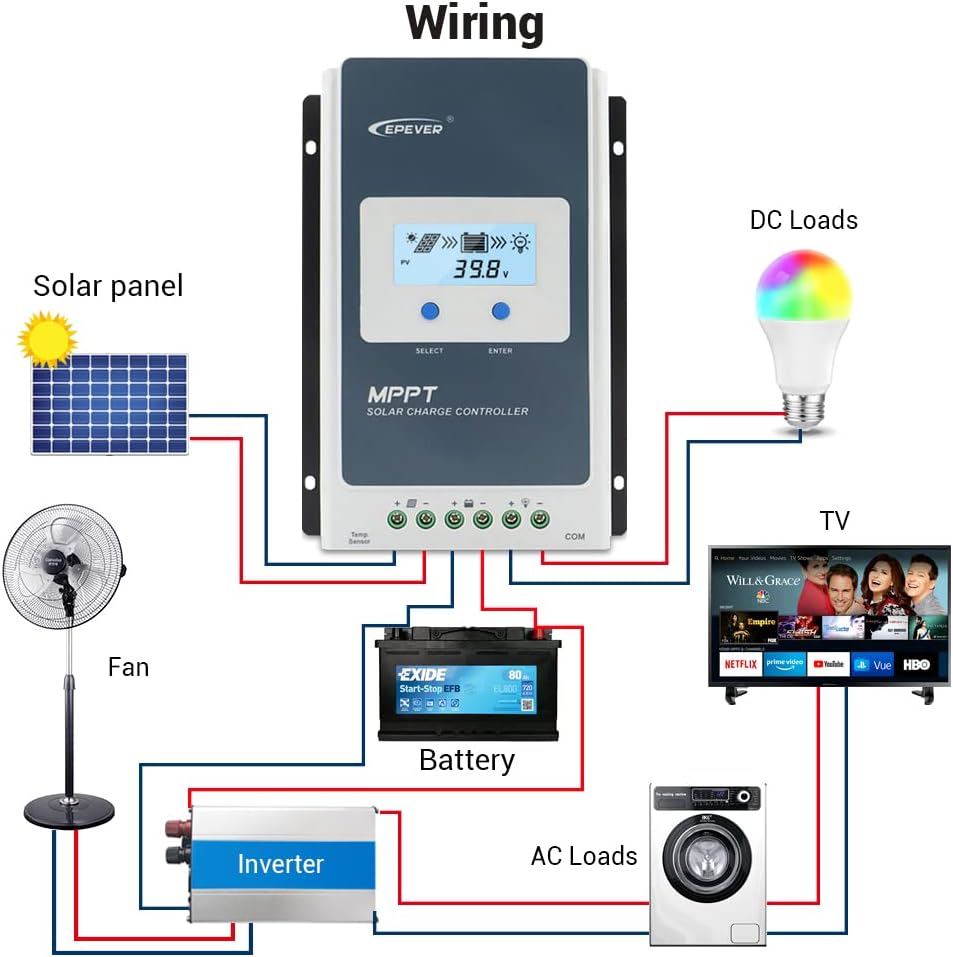
3.2 Diagrama de cableado
Connect the components in the specified order to prevent damage. The connection order is: Battery → Solar Panel → Load. The disassembly order is the reverse: Load → Solar Panel → Battery.
3.3 Communication Ports and Accessories
The controller features various ports for enhanced monitoring and control.

- Remote Temperature Sensor (RTS): Connect the RTS300R47K3.81A to the designated port for accurate battery temperature compensation. The standard cable length is 3m.
- Porto de comunicación RS485: This RJ45 port allows connection to various accessories for monitoring and parameter setting.
3.4 Pasos da instalación
- Mount the controller securely using the provided mounting holes.
- Conecta a batería aos terminais da batería do controlador. Asegúrate de manter a polaridade correcta.
- Connect the solar panel to the controller's solar panel terminals. Ensure correct polarity.
- Connect the DC loads to the controller's load terminals. Ensure correct polarity.
- Connect the temperature sensor probe to the controller.
3.5 Video: Unboxing and Installation
Watch this video for a visual guide on unboxing and installing the EPEVER Tracer-AN controller and its accessories.
4. Instrucións de funcionamento
This section covers basic operation and how to configure essential settings on your controller.
4.1 Modo de control manual
The controller supports manual control of the load. Press the 'ENTER' button to toggle the load on or off.
4.2 Setting the Battery Type
It is essential to set the correct battery type for optimal charging and battery longevity. The controller supports various battery types including Sealed (default), Gel, Flooded, and different Lithium battery configurations.
Para configurar o tipo de batería:
- Press and hold the 'ENTER' button for 5 seconds when the battery voltage interface is displayed.
- Press the 'SELECT' button when the battery type interface is flashing to cycle through available battery types.
- Press the 'ENTER' button to confirm your selection.
4.3 Setting the Load Mode
The load working mode determines how the connected DC loads operate. Options include Light ON/OFF, various timer settings, test mode, and manual mode.
To set the load mode:
- Press and hold the 'ENTER' button for 5 seconds when the load mode interface is displayed.
- Press the 'SELECT' button when the load mode interface is flashing to cycle through available modes.
- Press the 'ENTER' button to confirm your selection.
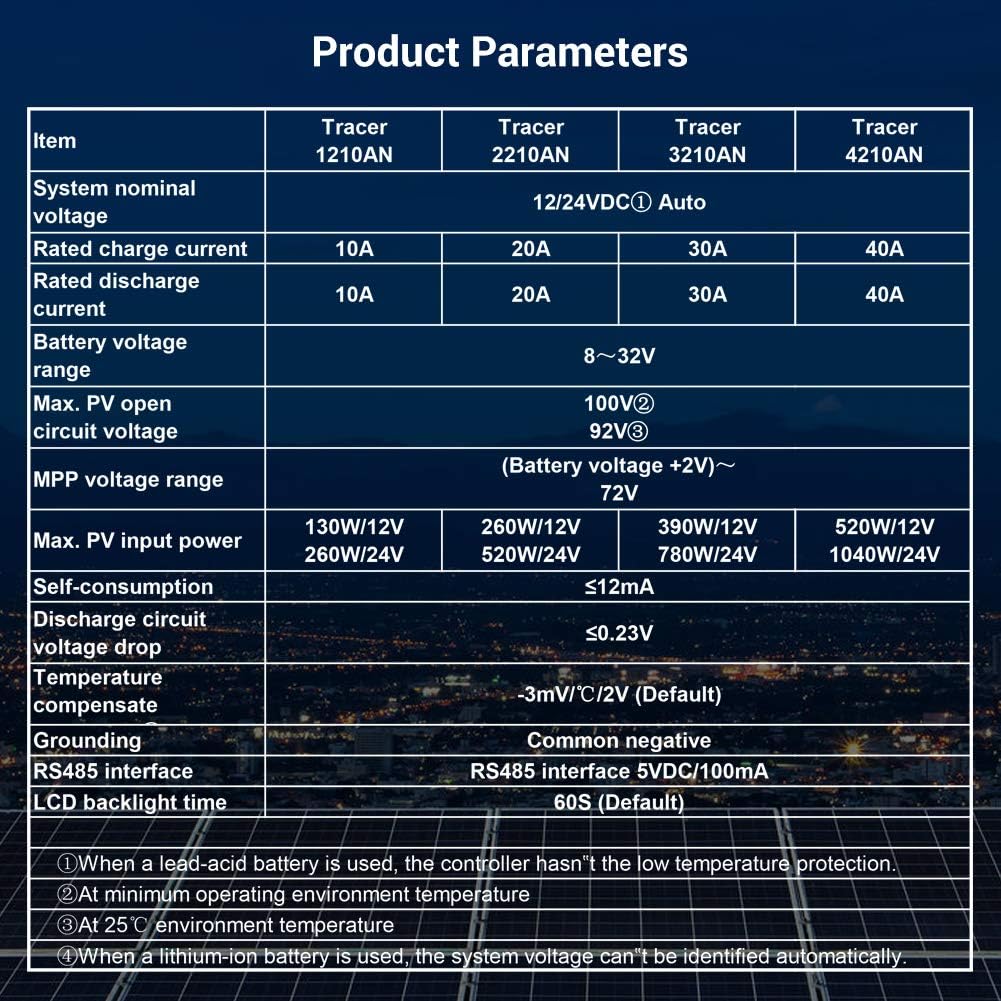
5. Especificacións
Below are the technical specifications for the Tracer1210AN MPPT Solar Charge Controller.
| Parámetro | Value (Tracer1210AN) |
|---|---|
| Vol. nominal do sistematage | 12 / 24VDC Auto |
| Corrente de carga nominal | 10A |
| Corrente nominal de descarga | 10A |
| Batería Voltage Alcance | 8 ~ 32 V |
| Máx. Circuito aberto PV Voltage | 100 V (a 25 °C de temperatura ambiental) |
| MPP Voltage Alcance | Batería Voltage +2V ~ 72V |
| Máx. Potencia de entrada PV | 130 W/12 V, 260 W/24 V |
| Autoconsumo | ≤ 12 mA |
| Circuito de descarga voltage Gota | ≤ 0.23 V |
| Temperature Compensate | -3mV/°C/2V (predeterminado) |
| Conexión a terra | Negativo común |
| Interface RS485 | 5VDC / 100mA |
| Tempo de retroiluminación LCD | 60S (predeterminado) |
6. Accesorios
The EPEVER Tracer1210AN controller is often bundled with or compatible with several accessories to enhance its functionality.
- MT50 Remote Meter: This remote meter can display various operating data and fault information. It features easy-to-operate buttons and a clear numeric display. It is used for monitoring and setting controller parameters.
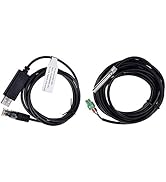
- Sensor de temperatura remoto (RTS300R47K3.81A): Acquires battery temperature for accurate temperature compensation of control parameters. The standard length of the cable is 3m.
- Cable USB a RS485 (CC-USB-RS485-150U): Used to connect the controller to a PC for monitoring and setting parameters via Solar Station PC software. The cable length is 1.5m.
- OTG Cable (OTG-12CM): Used to connect a mobile communication cable to achieve real-time monitoring and parameter modification via a mobile APP.
- WiFi Serial Adapter (eBox-WiFi-01): Allows monitoring and setting parameters via mobile APP software through WiFi signals.
- Adaptador de RS485 a Bluetooth (eBox-BLE-01): Enables monitoring and setting parameters via mobile APP software through Bluetooth signals.
- Rexistrador (eLOG01): Records the operating status of the controller for later review.

7 Solución de problemas
If you encounter issues with your EPEVER Tracer1210AN controller, refer to the following common troubleshooting tips:
- Sen visualización na pantalla LCD: Comprobe as conexións da batería e asegúrese de que o volume da bateríatage está dentro do rango operativo.
- Sen carga: Verify solar panel connections and ensure sufficient sunlight. Check for any shading on the solar panels. Confirm the battery type setting is correct.
- Carga non funciona: Check load connections and ensure the load mode is set correctly (e.g., Manual ON, Light ON/OFF). Verify that the battery voltage está por riba do baixo voltage disconnect threshold.
- Lectura de temperatura inexacta: Ensure the Remote Temperature Sensor (RTS) is properly connected and positioned near the battery.
- Problemas de comunicación: Check the RS485 cable connections to the remote meter, PC, or adapter. Ensure drivers are installed for PC communication.
For more detailed troubleshooting, consult the full product manual or contact EPEVER customer support.
8. Mantemento
Regular maintenance helps ensure the longevity and optimal performance of your solar charge controller.
- Limpeza: Manteña o controlador limpo e libre de po e residuos. Use un pano seco para limpar.
- Conexións: Comprobe periodicamente todas as conexións do cableado para comprobar se están ben apertadas e corroídas. As conexións soltas poden causar sobrequecemento e danos.
- Ventilación: Ensure adequate airflow around the controller to facilitate heat dissipation. Do not block the heat sink fins.
- Saúde da batería: Monitor de volumen de bateríatage and health regularly. Ensure the battery type setting on the controller matches your battery.
- Actualizacións de firmware: Consulte o do fabricante websitio web para ver se hai actualizacións de firmware dispoñibles para mellorar o rendemento ou engadir novas funcións.
9. Garantía e soporte
EPEVER products are designed for reliability and performance. For warranty information and technical support, please refer to the official EPEVER websitio web ou póñase en contacto co seu distribuidor local.
You can also visit the official iSunergy store on Amazon for product information and support: iSunergy Amazon Store.


