1. Introdución
The RADIOMASTER XR4 Gemini Xrossband Dual-Band Receiver is designed for remote control applications, offering reliable signal reception through its dual-band capabilities. It supports ExpressLRS Gemini Xrossband (Gem-X) protocol, operating on both 2.4GHz and Sub-G 900MHz frequencies. This manual provides essential information for the proper setup, operation, and maintenance of your XR4 receiver.
2. Contido do paquete
Verifique que todos os elementos que se indican a continuación estean incluídos no seu paquete:
- 1 x XR4 Gemini Xrossband Dual-Band Receiver
- 2 x Dual-Band T-Antenna
- 1 x fío CRSF
- 3 x Heat-Shrinkable Tube

This image displays the Radiomaster XR4 receiver board with its two dual-band T-antennas attached, illustrating the complete receiver assembly.
3. Características
- True Diversity & Dual-Band: Utilizes dual LR1121 RF transceivers for enhanced reliability.
- ExpressLRS Gemini Xrossband (Gem-X) Compatible: Supports 2.4GHz and Sub-G 900MHz bands.
- MCU de alto rendemento: Equipped with ESP32D4.
- Dual Semtech LR1121 Transceivers: Provides robust signal processing.
- Secondary UART Port: For advanced functionality and future expansion.
- Castled Pads: Facilitates easy soldering.
- Módulo Wi-Fi integrado: Simplifies firmware updates and configuration via WebUI.
- Ultra-Low Latency & High Refresh Rate: Ensures stable RF link.
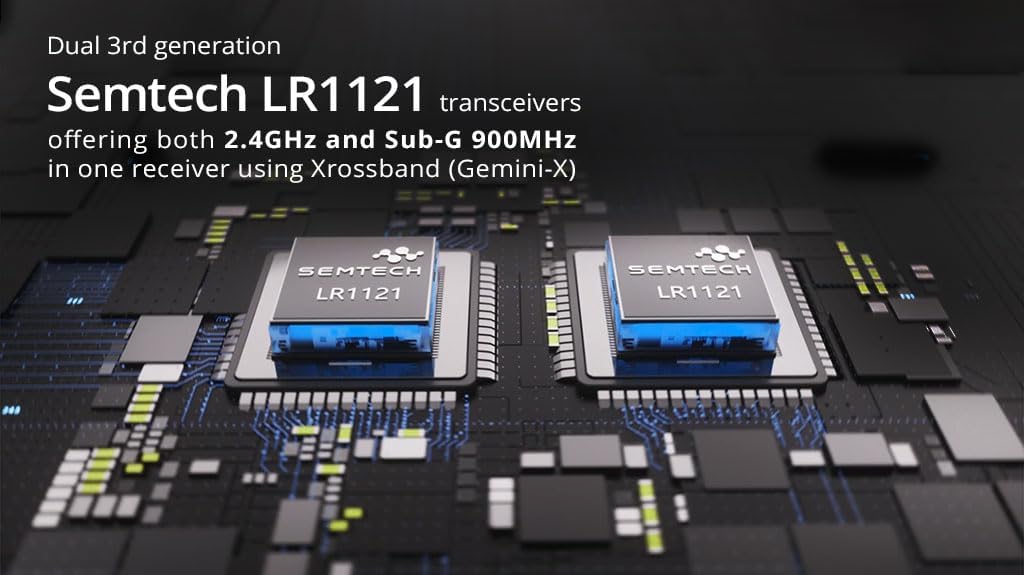
This image highlights the two Semtech LR1121 transceivers, which are central to the receiver's dual-band and true diversity capabilities.

Esta imaxe mostra un detalle view of the XR4 receiver board, specifically pointing out the additional UART port available for future expansion and advanced functionality.
4. Especificacións
| Parámetro | Valor |
|---|---|
| MCU | ESP32D4 |
| Chip RF | LR1121 x 2 |
| Conector RF | IPEX-1 x 2 |
| Antena | Dual-Band T Antenna x 2 (Included) |
| Rango de frecuencias | 2.4GHz / Sub-G 900MHz |
| Potencia de telemetría | 100 mW |
| Frecuencia máxima de actualización de recepción | DK500Hz/K1000Hz |
| Frecuencia mínima de actualización do receptor | 50 Hz |
| Traballo Voltage | DC 4.5-8.4V |
| Peso (sen antena) | 1.7 g |
| Dimensións | 22 mm x 18 mm x 4 mm |
| Firmware Version (pre-installed) | ExpressLRS v3.5.1 |
| Obxectivo FW | RadioMaster XR4 2.4/900 Gemini RX |
| Interface de bus 1 | CRSF |
| Interface de bus 2 | UART |
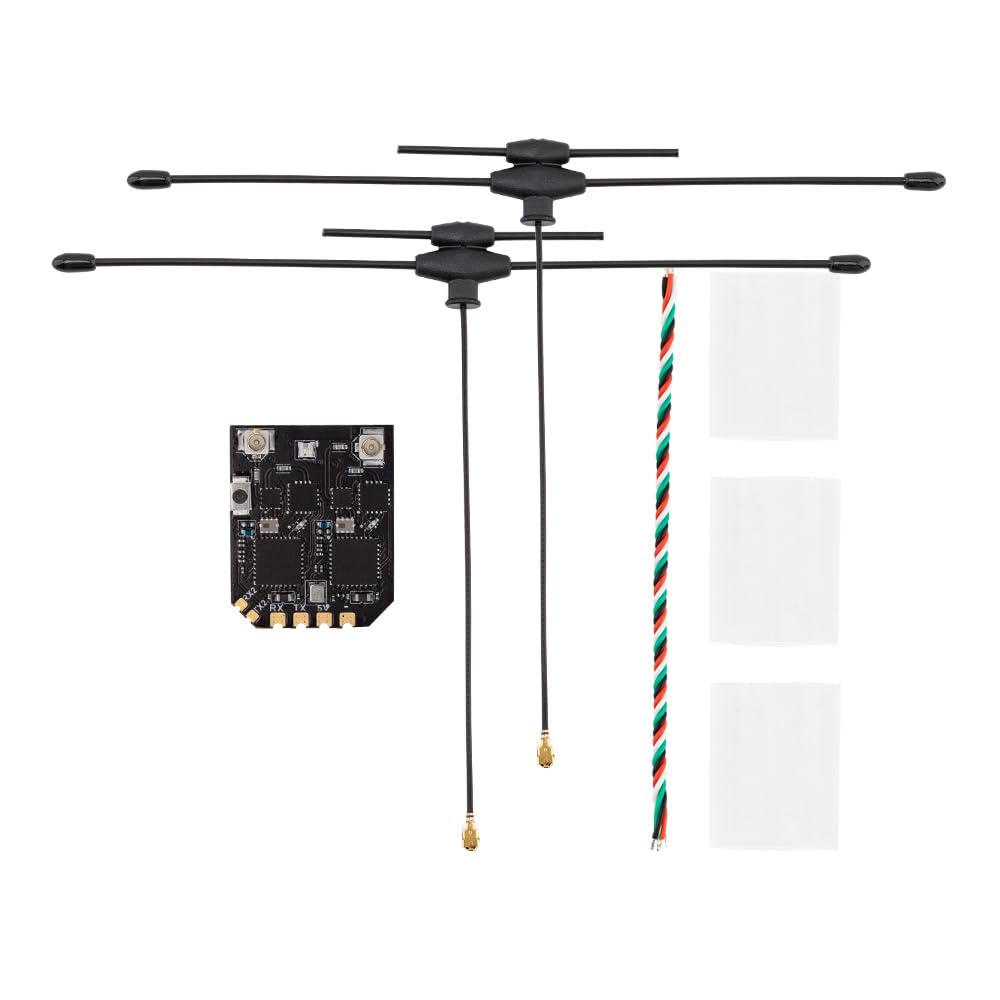
Esta imaxe ofrece unha clara vista de arriba abaixo view of the XR4 receiver's circuit board, showing component layout and connection points.
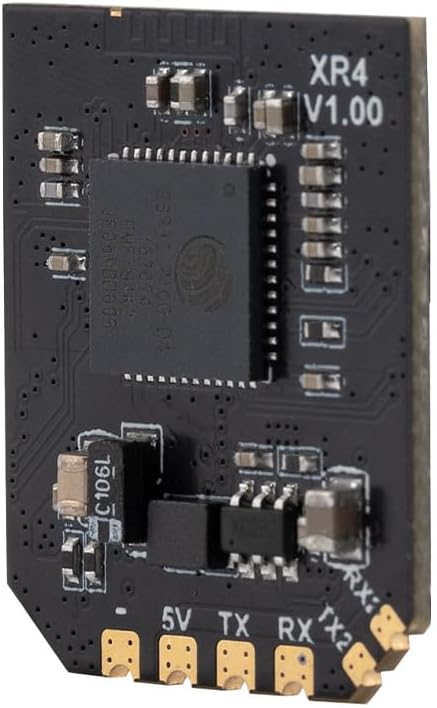
Esta imaxe mostra un profesional lateralfile of the XR4 receiver board, with "XR4 V1.00" clearly visible, indicating the model and version.
5. Configuración e instalación
5.1 Conexións de cableado
The XR4 receiver uses standard CRSF protocol for communication. Connect the receiver to your flight controller or other compatible device using the provided CRSF wire. Ensure correct polarity for power connections (DC 4.5-8.4V).
- 5 V: Power input (4.5-8.4V DC)
- GND: Terra
- TX: CRSF Transmit (connect to RX on flight controller)
- RX: CRSF Receive (connect to TX on flight controller)
- TX2/RX2: Secondary UART port for advanced functionality.
5.2 Instalación de antenas
Connect the two dual-band T-antennas to the IPEX-1 connectors on the receiver board. Position the antennas at a 90-degree angle to each other for optimal signal diversity. Use the provided heat-shrinkable tubes to secure and protect the antenna connections.
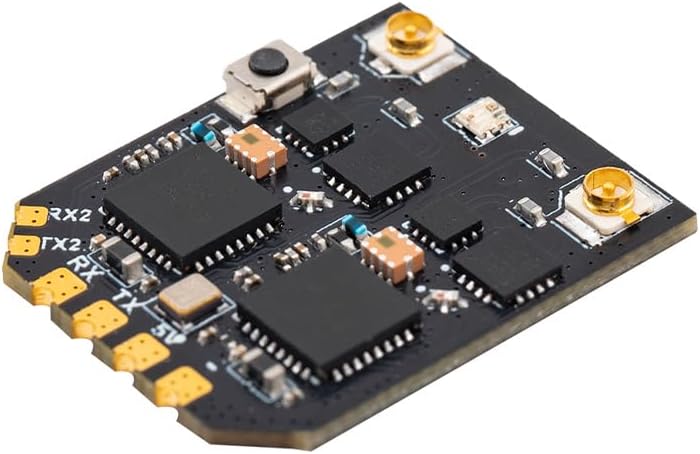
Esta imaxe mostra un ángulo view of the XR4 receiver board, highlighting the IPEX-1 antenna connectors and the soldering pads for power and CRSF communication.
6. Instrucións de funcionamento
6.1 Binding Procedure (ExpressLRS)
The XR4 receiver comes pre-installed with ExpressLRS v3.5.1 firmware. To bind the receiver to your ExpressLRS transmitter module, follow these general steps:
- Ensure your transmitter module is running a compatible ExpressLRS firmware version.
- Power on the receiver. It will enter binding mode if it does not find a valid link. The LED on the receiver will typically flash rapidly.
- On your ExpressLRS transmitter, initiate the binding process. This is usually done via the Lua script or a dedicated bind button/menu option.
- Unha vez conectado, o LED do receptor acenderase de forma fixa, o que indica que a conexión se realizou correctamente.
- If binding fails, ensure your transmitter and receiver have matching ExpressLRS firmware versions and binding phrases (if configured).
6.2 Operating Modes: Gemini and Xrossband (Gem-X)
The XR4 receiver supports various operating modes, leveraging its dual RF circuits:
- Gemini 2.4GHz: Uses two 2.4GHz antennas for dual-frequency operation within the 2.4GHz band.
- Gemini Sub-G 900MHz: Uses two 900MHz antennas for dual-frequency operation within the Sub-G 900MHz band.
- Xrossband (Gem-X): Utilizes one Sub-G 900MHz antenna and one 2.4GHz antenna for dual-band operation, providing enhanced reliability across different frequency ranges.
The specific mode is typically configured via the ExpressLRS Lua script on your transmitter or through the receiver's WebUI.

This diagram visually explains the different antenna configurations and packet transmission methods for Gemini 2.4GHz, Gemini Sub-G 900MHz, and Xrossband (Gem-X) dual-band modes.
7. Actualizacións de firmware
The XR4 receiver features an integrated Wi-Fi module for convenient firmware updates and configuration. To update the firmware:
- Acende o receptor.
- Connect to the receiver's Wi-Fi hotspot from your computer or mobile device. The network name will typically be "ExpressLRS RX" followed by a unique identifier.
- Abrir a web navegador e navegue ata http://10.0.0.1.
- Usa o WebUI to flash new firmware or adjust settings. Refer to the official ExpressLRS documentation for detailed instructions on firmware flashing.
8. Mantemento
The XR4 receiver requires minimal maintenance. Keep the device clean and free from dust and moisture. Regularly inspect antenna connections for damage. Ensure proper heat dissipation if operating in enclosed spaces.
9 Solución de problemas
- Sen ligazón/LED intermitente:
- Asegúrate de que o receptor estea alimentado correctamente (4.5-8.4 V).
- Verify the transmitter module is powered on and transmitting.
- Check if the receiver is in binding mode (rapid LED flash). If not, re-initiate binding.
- Confirm that the transmitter and receiver are running compatible ExpressLRS firmware versions.
- Check for correct binding phrase if one is set.
- Mala calidade do sinal/alcance:
- Inspect antennas for damage or improper connection.
- Ensure antennas are positioned optimally (e.g., 90 degrees to each other).
- Check for sources of interference near the receiver or antennas.
- Verify the selected operating mode (Gemini/Xrossband) is appropriate for your setup.
- O receptor non responde:
- Check all wiring connections (power, ground, CRSF TX/RX).
- Ensure the flight controller or connected device is configured correctly for CRSF protocol.
- Attempt a firmware re-flash if the receiver is unresponsive.
10. Información de seguridade
- Always ensure correct power polarity before connecting the receiver. Incorrect wiring can cause permanent damage.
- Operate RC equipment responsibly and within legal limits.
- Keep the receiver away from water, moisture, and extreme temperatures.
- Do not attempt to modify the receiver's hardware beyond specified connection points.
- Garantir unha ventilación adecuada para evitar o sobrequecemento.
11. Garantía e soporte
Para obter información sobre a garantía e asistencia técnica, consulte a páxina oficial de RADIOMASTER websitio web ou póñase en contacto co seu distribuidor autorizado. Garde o comprobante de compra para reclamacións de garantía.


